As Egypt’s real estate market matures, growth is increasingly defined by scale, adjacency, and long-term land strategy rather than isolated project launches. Developers are no longer just competing on individual compounds, but on their ability to create contiguous, integrated urban ecosystems that can sustain demand across cycles.
Palm Hills’ newly announced co-development agreement in West Cairo fits squarely within that shift.
The company has signed a partnership with Egyptian Kuwaiti Company for Real Estate Development to co-develop a 335-feddan mixed-use plot directly connected to Palm Hills October, expanding its total land bank to 40.5 million square meters.
Scale as Strategy, Not Expansion for Its Own Sake
At first glance, the headline number “1.4 million square meters of land” signals scale. But the more telling detail is where that land sits.
The plot is directly adjacent to Palm Hills October’s original phases, allowing Palm Hills to extend an existing community rather than create a standalone development. In a market where fragmentation often erodes long-term value, adjacency offers operational, commercial, and brand advantages that few developers can replicate.
This approach reflects a broader shift in how leading developers are thinking about growth: not as geographic sprawl, but as densification of proven demand corridors.
Long-Term Visibility in an Uncertain Market
The project is expected to generate approximately EGP 177 billion in sales over an eight-year period, with a planned launch in the first half of 2026 . That extended sales horizon is notable.
In volatile macro environments, developers with long land visibility and phased delivery models are better positioned to manage pricing, construction cycles, and demand fluctuations. Large-scale land banks provide optionality, allowing launches to be timed, products to be adjusted, and capital deployment to remain disciplined.
Palm Hills’ leadership has repeatedly emphasized this model, framing land accumulation not as inventory hoarding, but as a foundation for sustainable, scalable development.
Why West Cairo Continues to Attract Capital
West Cairo’s appeal is increasingly structural. The area combines relative openness, established residential demand, and connectivity to key infrastructure, from Sheikh Zayed City to transport corridors linking Greater Cairo’s westward expansion.
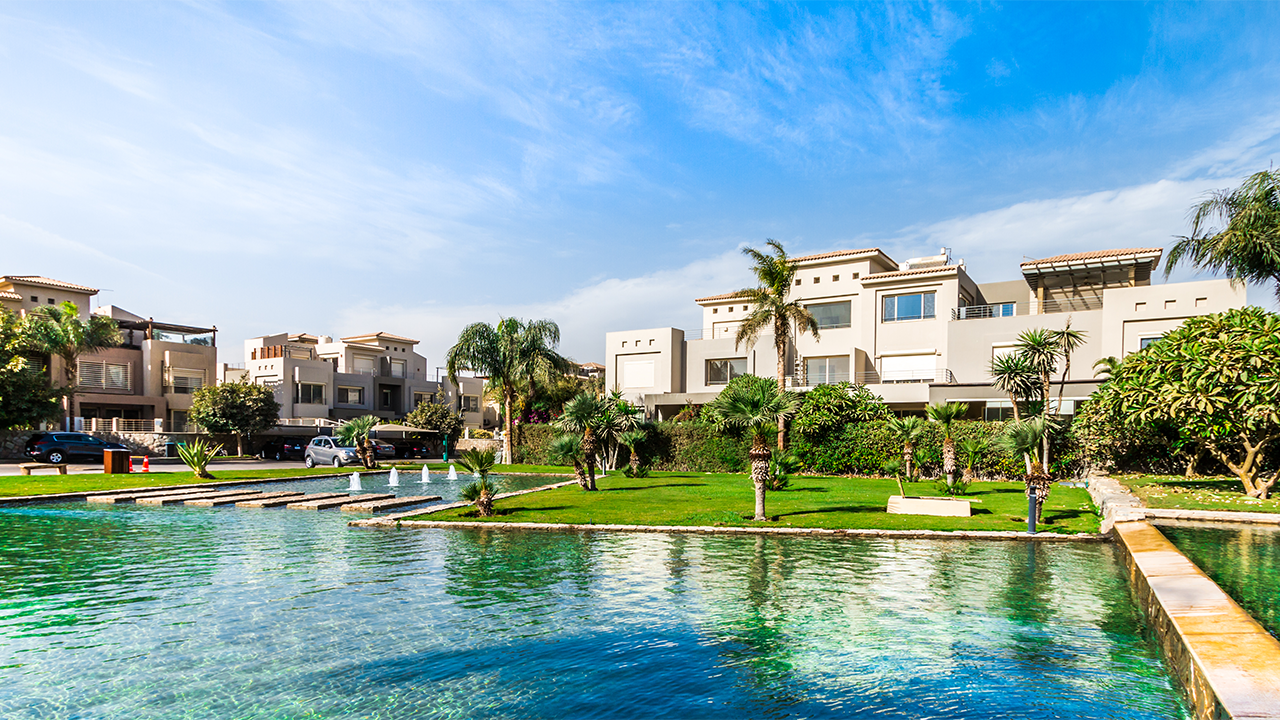
The newly announced project is designed as an upscale, integrated residential development, incorporating villas, townhouses, luxury apartments, and complementary commercial offerings. The master plan builds on the characteristics that have historically driven premiums in Palm Hills October, including elevation, views, and access to existing sports, retail, and lifestyle facilities.
Rather than repositioning West Cairo, the project reinforces its role as a core residential and lifestyle hub, capable of absorbing large-scale development without sacrificing coherence.
From Projects to Platforms
One of the subtler signals in the announcement is Palm Hills’ continued emphasis on platform-building rather than single-asset execution.
Across real estate, hospitality, and education, the company has been assembling interconnected verticals that support long-term community building and revenue diversification. The co-development agreement aligns with that strategy by extending an existing platform rather than starting anew.
In this context, land becomes more than a development input; it becomes a strategic asset that underpins future flexibility.
The Bigger Picture
As Egypt’s real estate sector enters a more selective phase, scale alone is no longer sufficient. Developers who succeed will be those able to combine land depth, disciplined execution, and an understanding of how cities expand organically over time.
Palm Hills’ latest West Cairo agreement reflects that mindset. It is less about announcing another project and more about reinforcing a long-term thesis: that the next phase of growth will be built by developers who think in districts, not developments.
If you see something out of place or would like to contribute to this story, check out our Ethics and Policy section.