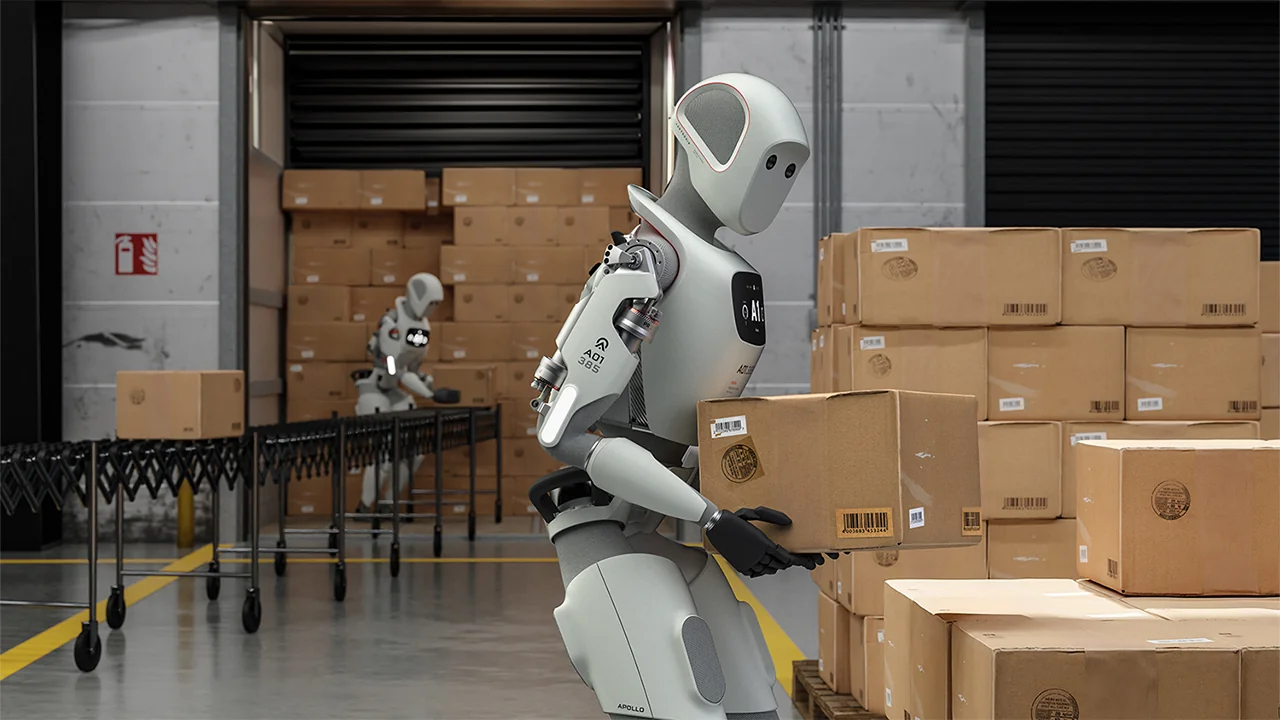
Humanoid robotics is edging closer to commercial reality, and sovereign capital is taking notice.
The Qatar Investment Authority (QIA) has joined a $520 million Series A-X extension round for Texas-based robotics company Apptronik, marking the fund’s latest move into frontier technology.
The extension follows Apptronik’s oversubscribed $415 million Series A raised in 2025, bringing the company’s total capital raised to nearly $1 billion. New investors in the round include AT&T Ventures and John Deere, alongside existing backers such as B Capital, Google, Mercedes-Benz, and PEAK6.
Betting on Scalable Humanoid Robotics
Apptronik is the developer of Apollo™, a humanoid robot designed to operate in logistics, manufacturing, and other mission-critical industries. Unlike research-focused humanoid prototypes, Apollo is positioned as a commercially deployable system capable of handling physically demanding, repetitive tasks, from component transport to sorting and kitting, while working alongside human teams.
The new capital will be used to accelerate production, expand pilot programs, and invest in facilities dedicated to robot training and data collection. The company is also preparing to debut a next-generation robot in 2026, signaling a roadmap that extends beyond early industrial deployments.
For QIA, the investment reflects a broader strategy of backing transformative technologies with long-term real-world applications. Humanoid robotics, particularly in industrial and logistics settings, sits at the intersection of labor market shifts, automation economics, and AI-driven physical intelligence.
From Research Labs to Production Floors
Apptronik emerged from the Human Centered Robotics Lab at the University of Texas at Austin and has spent nearly a decade developing humanoid platforms, including work on NASA’s Valkyrie robot. Today, the company employs close to 300 people and has positioned Apollo as a human-centered robot — designed not to replace workers outright, but to collaborate in physically intensive environments.
The funding round underscores how robotics is moving beyond proof-of-concept and into scaled manufacturing. State-of-the-art facilities for robot training and real-world data collection are becoming critical infrastructure for companies seeking to shorten time to market and improve deployment reliability.
Sovereign Capital and Frontier AI
QIA’s participation aligns with a broader trend of sovereign wealth funds increasing exposure to advanced AI and automation platforms. As robotics transitions from experimental technology to industrial tool, long-horizon capital is increasingly playing a role in supporting production scale rather than early-stage experimentation.
The presence of investors across telecom, agriculture, automotive, and technology sectors in the same round reflects the cross-industry relevance of humanoid robotics. From warehouses and factories to retail and healthcare, the commercial applications continue to expand.
The Bigger Picture
Humanoid robots have long occupied the realm of demonstration rather than deployment. What distinguishes the current wave is capital concentration behind companies preparing for scaled production.
By joining a $520 million extension round, QIA is effectively signaling confidence not just in a single company, but in the viability of humanoid robotics as a commercially scalable sector.
As Apollo moves further into industrial settings and as new iterations are unveiled, the question shifts from whether humanoid robots can operate alongside humans to how quickly they can become integrated into global supply chains.
If you see something out of place or would like to contribute to this story, check out our Ethics and Policy section.