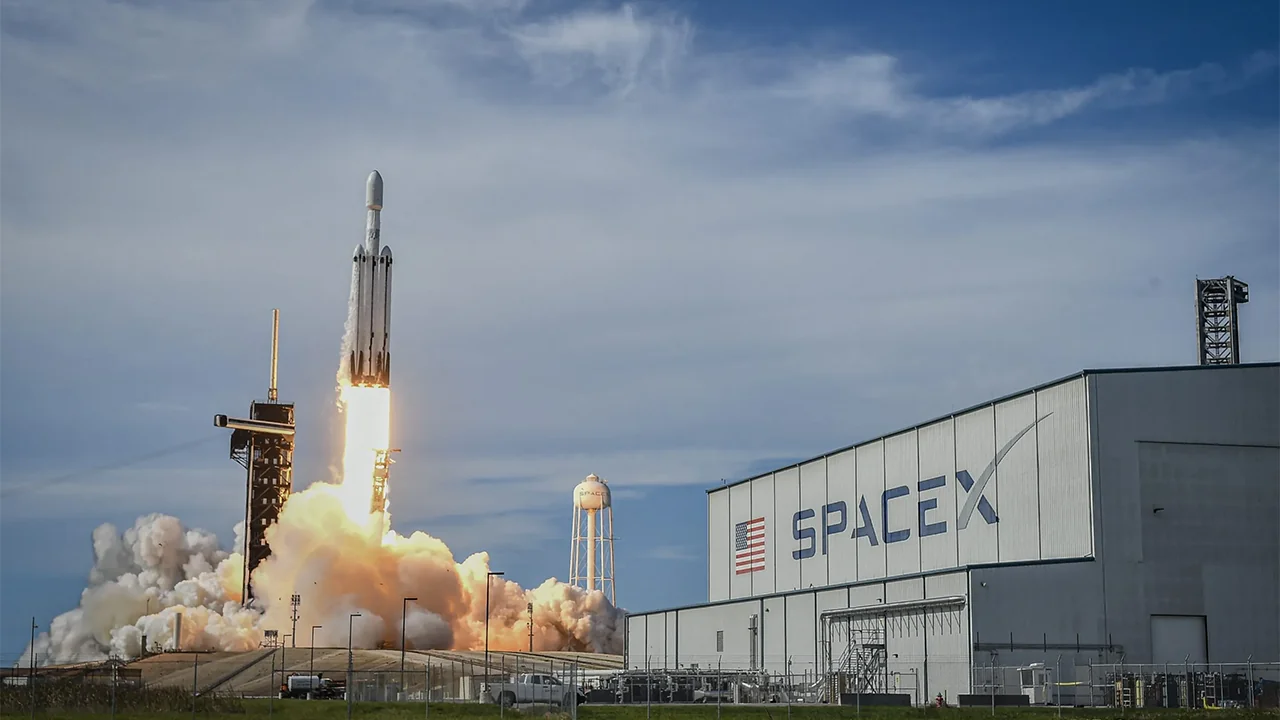
SpaceX has filed its S-1 registration statement with the US Securities and Exchange Commission ahead of a planned Nasdaq listing under the ticker SPCX. The roadshow begins June 4. The company plans to price on June 11 and list on June 12. SpaceX is targeting a valuation of $1.75 trillion and aims to raise up to $75 billion. That would make it the largest IPO in history, more than doubling Saudi Aramco’s $29 billion raise in 2019.
For two decades, SpaceX was the most consequential private company that no one outside venture capital circles could invest in. Elon Musk built it that way deliberately. The company raised private capital, ran secondary share sales at prices he controlled, and kept its finances away from public scrutiny. That changes in June 2026.
The S-1 filing is now public. SpaceX submitted a confidential version to the SEC on April 1, and for the first time, investors can see what the company actually looks like as a financial entity. The picture is more complicated than the valuation implies, and more interesting than most of the coverage has suggested.
Why You Should Care
The $1.75 trillion valuation puts SpaceX in the same bracket as Apple and Microsoft. It implies a revenue multiple of roughly 100 times trailing revenues. That figure only makes sense if you believe the company’s growth trajectory rather than its current financial position. In 2025, SpaceX generated $18.7 billion in revenue and lost $4.9 billion. The operating loss is driven almost entirely by one division. The AI segment, now called SpaceXAI, absorbed Musk’s xAI venture in an all-stock merger in February 2026.
That merger is the most consequential and least understood element of this IPO. Investors buying into SpaceX at a $1.75 trillion valuation are not simply buying a rocket company or a satellite internet business. In practice, they are buying a combined entity that includes xAI’s Grok AI models, its GPU infrastructure, and X, the social media platform formerly known as Twitter. The AI segment lost $6.4 billion in 2025. In Q1 2026 alone, the AI segment burned $7.7 billion in capital expenditure. By comparison, space consumed $1 billion and connectivity $1.3 billion in the same period.
For investors in the MENA region, the SpaceX IPO is the single most significant public market event of 2026. Satellite connectivity is a live strategic priority across the Gulf. Moreover, sovereign funds have been building exposure to US technology at scale. That said, this is also a genuinely difficult investment to evaluate.
The clearest way to understand SpaceX’s financial structure is to separate its three divisions and look at each independently.
Starlink, the satellite internet business, is the engine of the entire valuation. The business generated $11.4 billion in revenue in 2025 and $3.3 billion in Q1 2026, representing year-on-year growth of nearly 50%. Crucially, it is profitable at the operating level. Subscriber numbers reached 10.3 million by the end of March 2026, up from 9.2 million at the end of 2025. The network runs across more than 9,600 satellites in low Earth orbit. Analysts project Starlink revenues could reach between $16 billion and $24 billion by the end of 2026. This is not a speculative business. Rather, it is a growing, profitable subscription platform with global infrastructure that no competitor has yet matched.
The Space segment generated $4.1 billion in revenue in 2025 but ran at an operating loss of $657 million. Starship has consumed more than $15 billion in total development spending, exceeding SpaceX’s original budget. The company has been developing it for over a decade. SpaceX expects Starship to begin delivering payloads to orbit in the second half of 2026. However, that milestone is not guaranteed.
The AI segment is where the IPO story becomes genuinely difficult to assess. SpaceXAI lost $6.4 billion in 2025. It posted an operating loss of $2.5 billion in the first quarter of 2026 alone. Research and development costs within the AI segment increased by more than 300% in 2025, driven by GPU depreciation and cloud infrastructure spending. The segment does generate revenue: $818 million in the first quarter of 2026, primarily through Grok subscriptions and X. Even so, the losses are substantial and the path to profitability is not yet clear.
The Ripple
The governance structure of the post-IPO SpaceX is worth understanding before the revenue numbers. Musk holds approximately 42% of SpaceX’s equity but controls roughly 79% of its votes. A dual-class share structure assigns super-voting rights to his shares. In effect, public investors will own a minority economic stake in a company where one person retains near-total decision-making authority. That structure is not unusual in technology IPOs. Here, however, the concentration is particularly pronounced.
The filing also disclosed that SpaceX faces $530 million in legal costs linked to disputes arising from the xAI and X absorption. SpaceX also carries $25.45 billion in contractual commitments, primarily for cloud computing, with 95% due in 2026 and 2027.
For the broader public markets, a SpaceX listing at $1.75 trillion has structural consequences beyond the company itself. Fast-track entry into the Nasdaq 100 and potentially the S&P 500 would trigger forced buying from index funds and ETFs. That demand pressure has nothing to do with fundamental valuation. Analysts describe this as an index-demand effect that could push the stock above its IPO price in the weeks following the listing, regardless of fundamentals.
The underwriting syndicate, Bank of America, Goldman Sachs, JPMorgan Chase, and Morgan Stanley, represents the senior tier of US investment banking. The roster signals institutional confidence in the deal’s marketability, not necessarily in its valuation.
What to Watch
The roadshow begins June 4. That is when SpaceX and its underwriters formally pitch the offering to institutional investors. It is also when market pricing pressure becomes visible. Specifically, the gap between the $1.75 trillion target and the final IPO price will show how institutions are weighing Starlink’s growth against the AI segment’s losses.
Starship remains the highest-stakes near-term variable. SpaceX has committed publicly to Starship delivering payloads to orbit in the second half of 2026. SpaceX spent $3 billion on Starship R&D in 2025 and $930 million in Q1 2026 alone. A delay of any significance would alter the financial projections that underpin the valuation. Starship’s twelfth test mission is expected this week.
The longer question is what SpaceX actually is once it is public. The xAI merger has transformed SpaceX from a space and connectivity company into something without clear precedent in public markets. Furthermore, no comparable peer group exists for valuation purposes. Investors are being asked to price a combined entity spanning launch services, satellite internet, AI infrastructure, and social media. All of it sits under one shareholder who has stated clearly that his mission is to extend human civilization beyond Earth. Depending on your view of that mission, the $1.75 trillion valuation either makes sense or it does not.
If you see something out of place or would like to contribute to this story, check out our Ethics and Policy section.