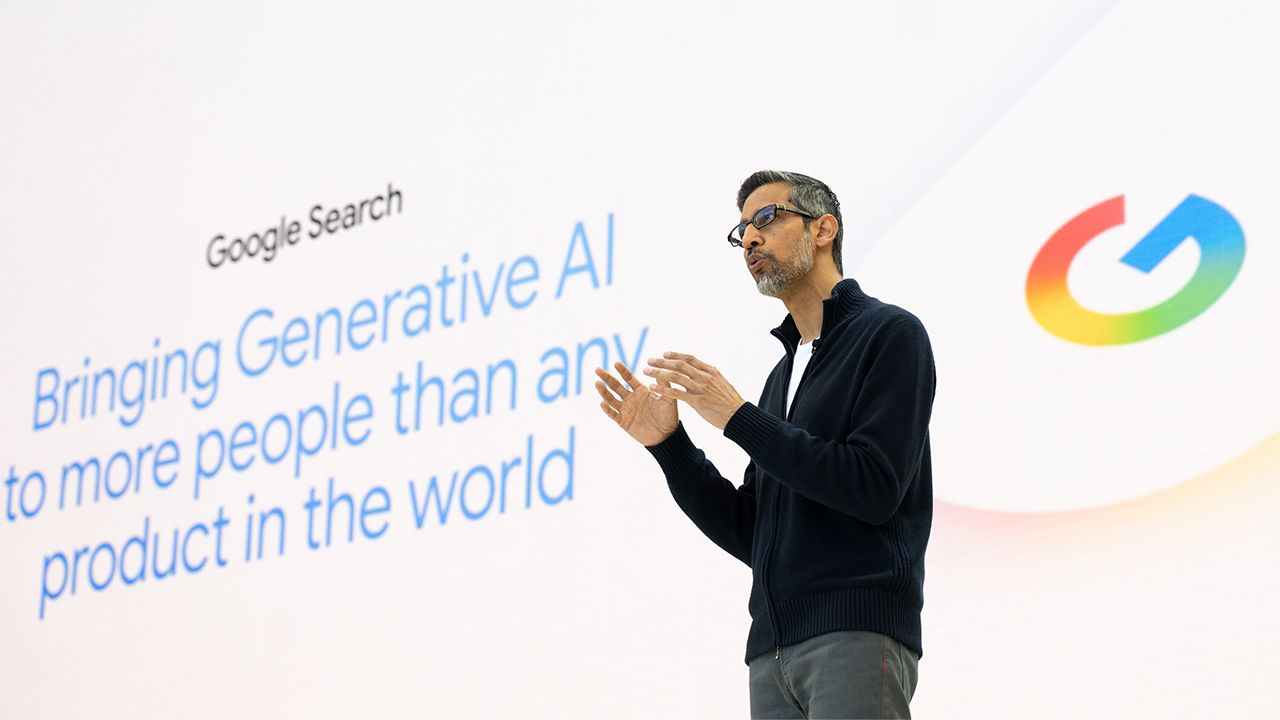
Google has announced a sweeping overhaul of Search at its annual I/O developer conference. The updates include a redesigned AI-powered search box, the debut of persistent AI agents that monitor the web on your behalf, agentic booking and calling capabilities, real-time generative UI built on the fly, and a global expansion of Personal Intelligence to nearly 200 countries. AI Mode, which launched one year ago, has surpassed one billion monthly users.
For twenty-five years, the Google search box was one of the most stable pieces of digital infrastructure on earth. A rectangle. A cursor. A button. The world typed into it roughly eight billion times a day, and Google returned links. That era ended this week.
The announcements at I/O 2026 are not incremental improvements to an existing product. They represent a deliberate architectural shift in what Search is: from a tool that retrieves information to a system that acts on your behalf, monitors the world in the background, builds software on demand, and learns your personal context over time. The word “search” may become a misnomer.
Why You Should Care
The scale of AI Mode’s adoption is the most important context for understanding why these announcements matter. One year after its debut, AI Mode has surpassed one billion monthly users, with queries more than doubling every quarter since launch. That growth rate, sustained over four consecutive quarters, signals a genuine behavioral shift, not novelty adoption. People are not just trying AI Search. They are changing how they use the internet.
The redesigned search box is the most visible change but not the most consequential. The intelligent search box dynamically expands to give users space to describe exactly what they need. It offers AI-powered suggestions that go beyond autocomplete and accepts text, images, files, videos, and Chrome tabs as inputs. That multimodal input capability matters more than the visual redesign. The ability to paste a document, a screenshot, or a video into a search query and receive a synthesized response changes the relationship between a user and an information system fundamentally.
The more consequential development is the introduction of information agents. Operating in the background, 24/7, these agents intelligently reason across information to find exactly what you need at exactly the right moment. A user can describe a complex, ongoing information need: tracking apartment listings, monitoring for athlete endorsement announcements, watching for price changes. The agent handles it continuously without further input. Information agents will launch first for Google AI Pro and Ultra subscribers this summer.
For businesses, the agentic booking and calling capabilities represent a more immediate disruption. For select categories like home repair, beauty, and pet care, users can ask Google to call businesses on their behalf. That capability removes a human step from the conversion funnel. It also shifts how businesses think about their digital presence in ways that are only beginning to be understood.
The Ripple
The generative UI capability deserves particular attention. Search can build the ideal response in the right format for any question, completely on the fly, including custom layouts, interactive visuals, tables, graphs, and simulations in real-time. Beyond one-off responses, Search can build custom dashboards and trackers that users return to over time. Google describes these as “mini apps for your own specific tasks.”
This is a direct challenge to the entire category of lightweight software products. A fitness tracker, a wedding planner, a home move checklist, a budget calculator. Any tool that a user currently downloads, subscribes to, or bookmarks is now something Google can generate and maintain on demand. The implications for the app economy are significant and are only beginning to be understood.
The Personal Intelligence expansion is the quietest but potentially most structurally important announcement. Personal Intelligence in AI Mode is expanding to nearly 200 countries and territories across 98 languages, with no subscription required. Users can securely connect apps like Gmail and Google Photos, and soon Google Calendar. A search engine that knows what is in your email, your photos, and your calendar is not a search engine in any conventional sense anymore. It is closer to an operating system for your information life. Extending that to 200 countries at no additional cost represents an infrastructure-level move.
What to Watch
The agent capabilities launching first for paid subscribers signals that Google is using AI Pro and Ultra subscriptions as both a revenue mechanism and a testing layer before broader rollout. The pace at which information agents and agentic calling move from paid to free tiers will indicate how quickly Google believes the technology is ready for mass deployment. It will also show how aggressively it is willing to compress the competitive window for rivals.
The generative UI and mini apps capability, available in the coming months starting with paid subscribers in the US, will attract close scrutiny from the developer and startup community. If Google can generate functional, personalized software on demand at the moment of a search query, the value proposition of lightweight consumer apps changes fundamentally.
The deeper question is regulatory. A product that reads your email, monitors the web on your behalf, calls businesses for you, and generates software tailored to your needs sits across data privacy, competition, and communications regulation at once. European regulators in particular will be watching the Personal Intelligence rollout closely.
If you see something out of place or would like to contribute to this story, check out our Ethics and Policy section.