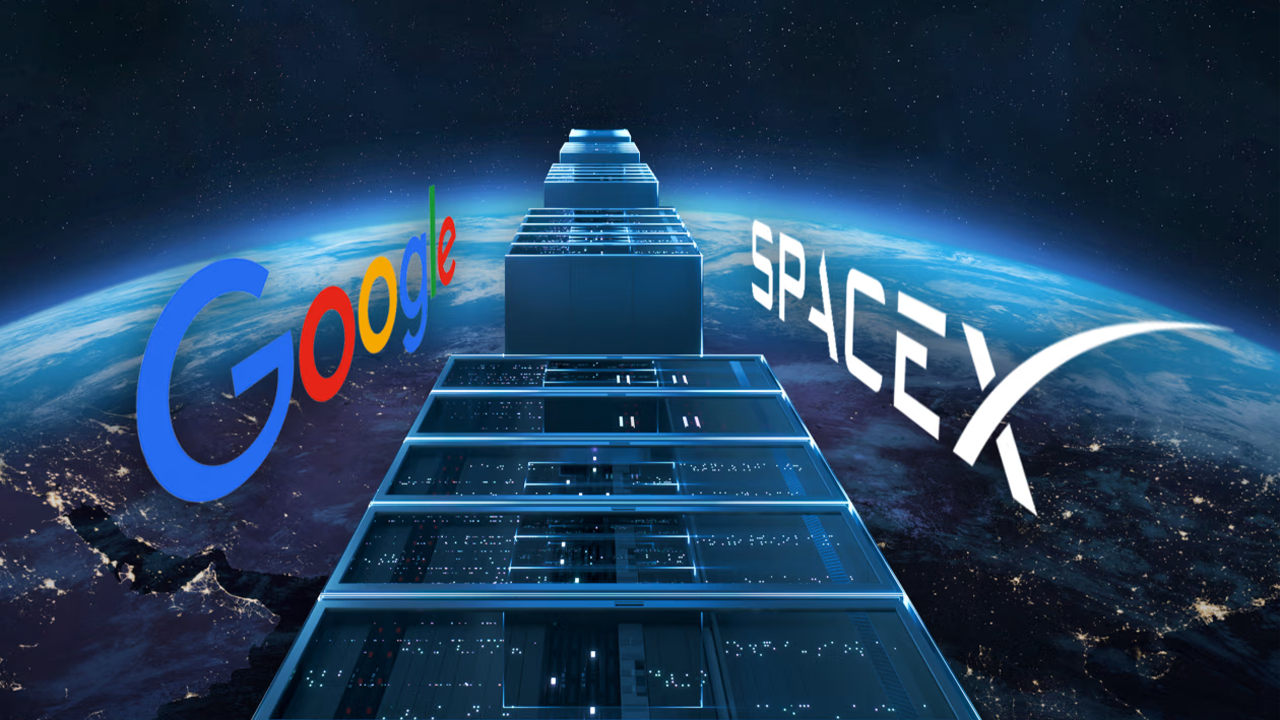
The tech giant is developing “Project Suncatcher,” a plan to connect solar-powered satellites equipped with AI chips into an orbital cloud network.
Google is exploring one of Silicon Valley’s most ambitious infrastructure bets yet: moving AI data centers into space.
The company confirmed it has been in discussions with Elon Musk’s SpaceX and other launch providers regarding future launches tied to “Project Suncatcher,” an orbital data center initiative designed to create a space-based AI cloud network.
Why You Should Care
AI infrastructure is becoming one of the most competitive battlegrounds in tech. Companies are racing to secure enough computing power and energy capacity to support increasingly resource-intensive AI models.
Google’s orbital data center concept points to how major tech firms are beginning to think beyond terrestrial infrastructure constraints, particularly around energy consumption, cooling systems, and access to large-scale computing capacity.
If successful, the project could open a new frontier for AI infrastructure and satellite-based computing.
Google’s Project Suncatcher aims to network solar-powered satellites equipped with the company’s Tensor Processing Units, or TPUs, into an orbital AI cloud. Reuters reported that the company plans an initial prototype launch with satellite imaging company Planet Labs around 2027.
The discussions with SpaceX are particularly notable given Musk’s long and complicated history with Google and OpenAI. Musk co-founded OpenAI in 2015 partly as a counterweight to Google’s growing AI ambitions before later distancing himself from the company over disagreements surrounding AI safety and strategy.
A potential partnership would also position SpaceX deeper inside the fast-growing AI infrastructure economy ahead of its widely anticipated IPO. Reuters noted that this would mark another instance of Musk working alongside an AI rival he has publicly criticized in the past.
The broader concept of orbital data centers is gaining attention as AI companies confront growing energy demands on Earth. Space-based systems could theoretically rely on continuous solar power while reducing some cooling and land usage constraints associated with traditional data centers.
The Ripple
The project highlights how the AI race is increasingly intersecting with the commercial space industry.
Launch providers such as SpaceX could benefit from rising demand for satellite deployments tied not only to communications and defense, but also computing infrastructure. At the same time, cloud and AI companies are starting to treat space as a potential extension of digital infrastructure rather than purely a connectivity layer.
The development may also intensify competition between hyperscalers as firms search for alternative ways to scale AI capacity beyond conventional data center models.
What to Watch
The key milestone will be Google’s planned prototype launch around 2027 and whether the company can demonstrate that orbital AI infrastructure is technically and economically viable.
Investors and the broader tech industry will also be watching whether Project Suncatcher evolves into a long-term commercial platform or remains an experimental research initiative.
For SpaceX, any future agreement with Google could further expand the company’s role in AI-related infrastructure as demand for launch capacity continues to grow alongside the AI boom.
If you see something out of place or would like to contribute to this story, check out our Ethics and Policy section.