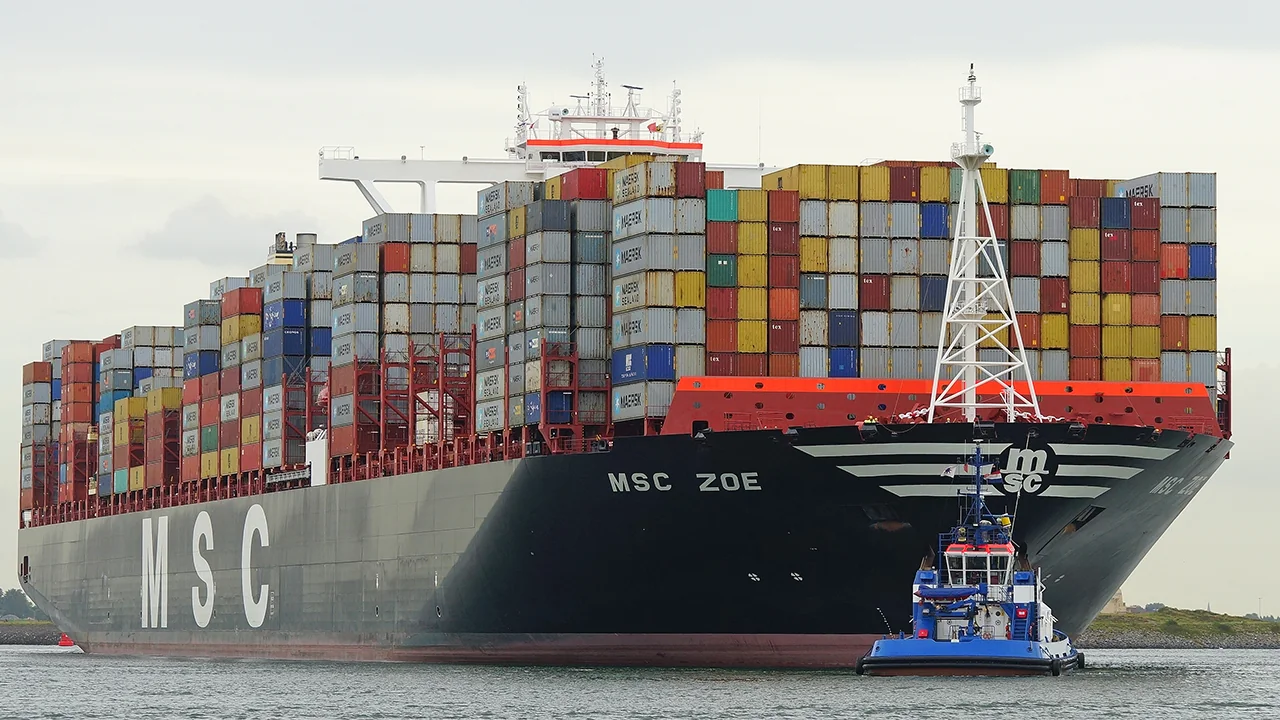
The world’s largest container carrier is redrawing the map between Europe and the Gulf, replacing a single sea route with a hybrid network across Saudi Arabia.
MSC Mediterranean Shipping Company launched a new Europe–Red Sea–Middle East Express service. The service combines sea, land, and feeder connections to maintain cargo flows as disruption continues in the Strait of Hormuz.
The first sailing is scheduled for May 10 from Antwerp, linking key European ports to Red Sea hubs including King Abdullah Port, Jeddah, and Aqaba. From there, cargo will move overland across Saudi Arabia before reconnecting to Gulf ports such as Jebel Ali and Abu Dhabi.
Why You Should Care
This is not just a new shipping line. It is a workaround to one of the most critical chokepoints in global trade.
The Strait of Hormuz, a vital artery for both energy and container traffic, has seen severe disruption following escalating geopolitical tensions since late February. As reliability breaks down, shipping lines are being forced to rethink how goods move between Europe and the Gulf.
MSC’s response is a multimodal landbridge. Instead of relying entirely on sea transit, containers will travel by truck roughly 1,300 kilometers across Saudi Arabia, from Red Sea ports to Dammam on the Gulf coast, before continuing by feeder vessels.
The trade-off is clear. The route offers continuity, but at a cost of longer transit times, higher expenses, and increased emissions due to road transport.
The new Eastbound rotation includes Gdansk, Klaipeda, Bremerhaven, Antwerp, Valencia, Barcelona, Gioia Tauro, and Abu Kir before reaching Saudi ports and Aqaba.
From Saudi Arabia, cargo is transported inland via Riyadh to Dammam, where it is redistributed to regional hubs across the UAE and Upper Gulf. Additional feeder connections extend to Bahrain, Iraq, and Kuwait, integrating more markets into this alternative network.
MSC said the new service responds to “the growing demand of services from Europe to the Red Sea and to the challenging scenario in the Middle East.”
The launch reflects a broader shift across the shipping industry, as carriers prioritize reliability and route flexibility amid ongoing disruption in the region.
Carriers including Hapag-Lloyd and Maersk have already introduced similar landbridge models across Saudi Arabia and Oman. This indicates the solution is becoming an industry-wide adjustment rather than a one-off solution.
The Ripple
The shift is accelerating investment and activity across alternative trade corridors.
Ports outside the Strait of Hormuz, particularly in Oman and along the UAE’s eastern coast, are seeing increased cargo volumes as shipping lines reroute flows.
For Saudi Arabia, the impact is tangible. Moving cargo across the country positions it as a central link between two major trade basins, reinforcing its push to expand its role in global supply chains.
For operators and investors, the signal is clear. Disruption is not just redirecting cargo; it is redistributing value across new nodes in the region. Companies positioned in ports, inland transport, and logistics services stand to capture that shift.
What to Watch
Watch how quickly carriers scale landbridge capacity across Saudi Arabia.
More shipping lines will test hybrid sea–land routes if disruption in Hormuz continues. Early movers will secure trucking capacity, inland routes, and port slots before the network tightens.
Track how Gulf ports respond. Increased volumes will push operators to expand handling capacity and improve turnaround times.
Pay attention to Saudi Arabia’s logistics buildout. Faster coordination between ports, trucking, and customs will determine whether this model holds at scale.
The direction is clear. Trade flows are shifting. The winners will move early and lock in access to these new corridors.
If you see something out of place or would like to contribute to this story, check out our Ethics and Policy section.